
A pantry or butler's cold room is a small walk-in inside the house, cooled by a dedicated refrigeration unit. It needs proper insulation, a vapor barrier, a sealed door and somewhere for the heat and condensate to go. Most problems are condensation, poor sealing, noise and undersized or unsuitable cooling equipment.
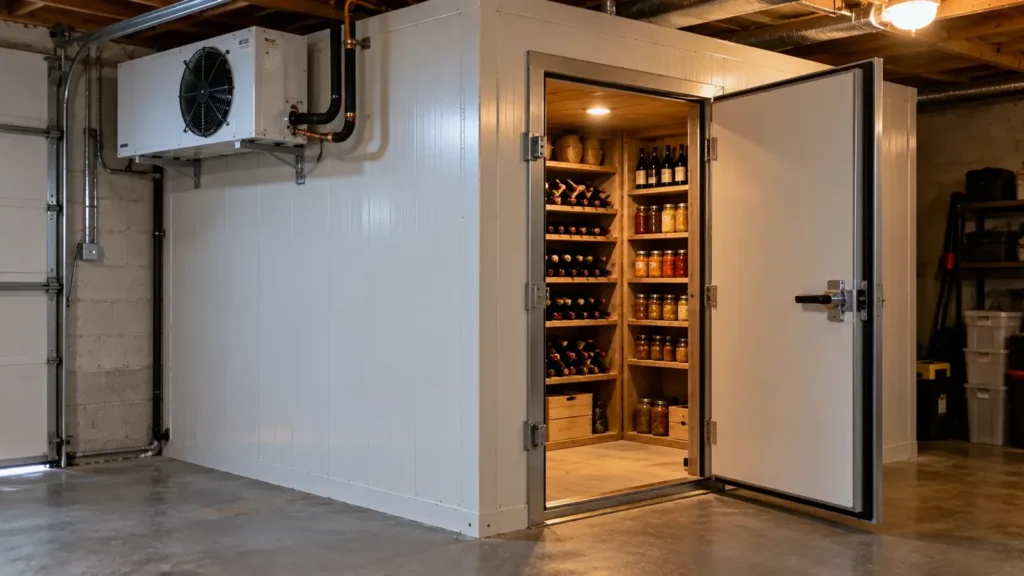
Cold pantries are becoming popular in new and remodeled homes, especially for families who cook in bulk, entertain often or keep drinks and produce close to the kitchen. Because they sit inside the house, mistakes in design show up as sweating walls, mold and comfort problems.
How a cold room is cooled
- Split system. An evaporator inside the room and a condensing unit outside the house. Quiet and efficient, but needs line sets and a drain.
- Through-wall unit. A self-contained unit that vents to another space. Simpler, but the heat has to go somewhere suitable.
- Converted air conditioner. Cheaper, but often freezes up below normal room temperatures. See why AC conversions freeze up.
Design details that matter
| Detail | Why it matters |
|---|---|
| Insulation | Keeps the cold in and the room from overworking |
| Vapor barrier on the warm side | Stops moisture from condensing inside walls |
| Insulated, gasketed door | Prevents air leaks and frost |
| Condensate drain | Removes water from the coil |
| Heat discharge location | Heat must not dump into a closed closet or attic |
| Electrical circuit | Dedicated and correctly sized |
In Hattiesburg's humidity, the vapor barrier and door seal are the details most often done poorly. See insulation, panels and floors.
Common problems
- Sweating walls or ceilings outside the cold room.
- Mold or musty smell in the room or adjacent closets.
- Ice on the coil and water on the floor.
- Room never gets cold enough on hot days.
- Noisy unit disturbing the house.
- Door that does not seal or close on its own.
What you can check
- Door seal. Close it on a strip of paper. It should hold all around.
- Coil and fans. Are fans turning, is there ice?
- Drain. Is water draining away or pooling?
- Heat discharge. Is the unit able to breathe?
- Temperature. Use a thermometer and log a few readings.
When to call
Call if the room stays warm, ices up, leaks water or causes condensation in the house. A technician can check the refrigeration side and tell you whether the problem is equipment or construction. See condensation and humidity and the home walk-in repair page.
Living with a cold pantry
Treat the door like a refrigerator door: close it every time. Keep the room organized so you can grab items quickly, and leave space around the cooling unit. Wipe up spills, check the drain every few months and keep an eye on walls next to the room for any sign of dampness. A small thermometer with a high-low memory is a cheap way to see how steady the room really is.
Questions about pantry and butler's cold rooms
Can a cold pantry cause mold in my house?
Yes, if the vapor barrier or door seal is poor. Fix leaks early.
Is a window air conditioner enough to cool a pantry?
Sometimes for mild targets, but it often freezes up. A proper refrigeration unit is more reliable.
Where should the heat from the unit go?
Outside or to a large ventilated space, never a closed closet or attic.