
Farm and market walk-ins handle field heat, harvest surges, humidity and outdoor exposure. Common failures are dirty condensers, overloading, airflow problems, drains and electrical damage from storms. Pre-cool produce where possible, load in stages, keep the unit clean and call for repair at the first warm reading.
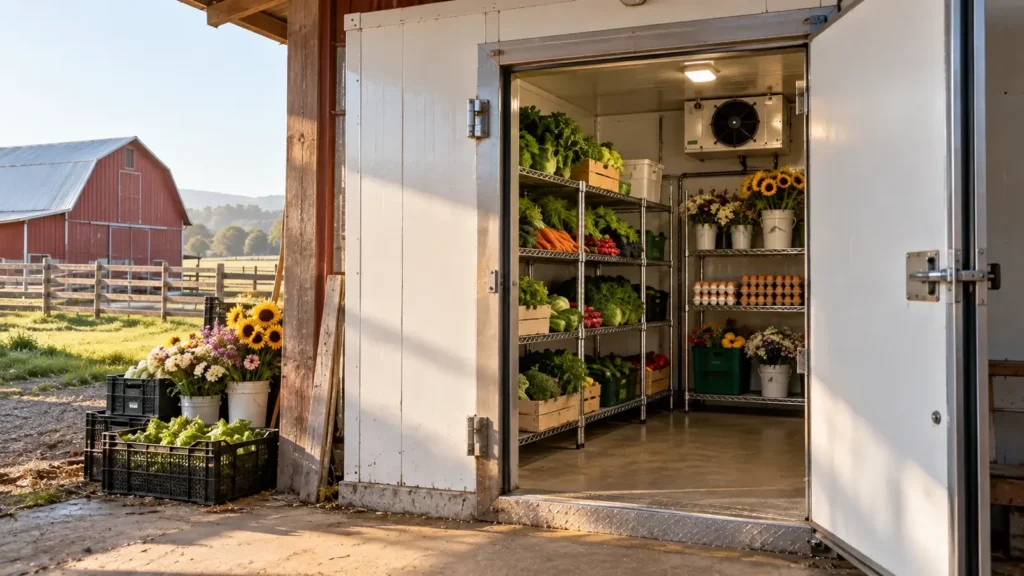
Small farms, orchards, U-pick operations and market vendors across Forrest, Lamar and neighboring counties use walk-in coolers to hold produce, eggs, flowers and value-added products. The box has to work hardest in exactly the weeks when nobody has time to watch it.
How farms and markets use walk-ins
Produce comes in from the field warm, sometimes wet and in large volumes. The box has to remove that field heat quickly to protect quality and shelf life. Vendors may load the night before a market and unload the next morning. Eggs, dairy and some value-added foods have their own temperature and handling requirements.
Where the pressure comes from
| Pressure point | What tends to fail |
|---|---|
| Field heat at harvest | System cannot pull down the load |
| Wet produce and high humidity | Coil icing, drain problems, mold |
| Outdoor or barn location | Dirty coils, pests, weather damage |
| Storms and rural power | Surges, outages, tripped breakers |
| Seasonal idle periods | Failures on first start |
| DIY or converted boxes | Undersized or unsuitable equipment |
Temperature and humidity for produce
Different crops prefer different conditions. Many leafy greens and roots like it cold and humid, while tomatoes, sweet potatoes and some fruit are damaged by cold. One box cannot suit everything, so many farms choose a compromise or use more than one space. Mississippi State University Extension publishes post-harvest guidance for growers, which is the best place to check crop-specific targets. If produce is freezing in one spot, see too cold and freezing produce.
Common repairs
- Condenser cleaning and fan repair for heat problems. See the condenser coil.
- Evaporator, fan and defrost repairs for icing. See the evaporator coil.
- Drain clearing and heater repairs. See drain line heater.
- Electrical repairs after storms. See surge protection.
- Door and gasket work. See door gasket.
Harvest-season habits
- Harvest in the cool of the morning where you can.
- Pre-cool with shade, fans or hydro-cooling before loading.
- Load in batches and let the box recover between them.
- Leave space between crates for airflow.
- Keep a thermometer and check it morning and evening.
- Keep the door closed during field work.
Food safety for sellers
If you sell eggs, cut produce, dairy or prepared foods, rules on temperature and handling apply. Keep a log, use a probe thermometer and ask the Mississippi State Department of Health or the Mississippi Department of Agriculture and Commerce what applies to your products. See food safety in Mississippi.
If the walk-in fails during harvest
Move the most valuable or perishable crops to any other cold space, keep the door shut and call for repair. A refrigerated trailer rental can save a harvest during a long repair. Record what was lost for insurance. See spoilage insurance.
What to tell us when you call
- The farm location and how to reach the walk-in.
- What crops are inside and the temperature.
- Whether the unit is outdoors, in a barn or a converted building.
- Whether it was recently loaded with field-warm produce.
- Any ice, water, noise or storm history.
See also the homes, hunters and farms guide.
Keeping records for buyers and inspectors
Restaurants, grocers and market managers increasingly ask farms how produce was handled. A simple temperature log and notes on cleaning show care and protect your reputation. Keep invoices for repairs, especially after a failure, and write down what you did with any product that warmed. See temperature logs.
Off-season care
After the last harvest, empty and clean the box, wash and dry shelves and crates, clear the drain and decide whether to leave the system running. If you shut it down, prop the door so it can dry. Before the next season, start it early and watch it for a week before you rely on it.
Questions about farm, market and small-producer walk-in cooler repair
Can one walk-in hold all my crops?
Often not ideally. Some crops are damaged by cold. Many farms compromise or use two spaces.
Why does my farm cooler freeze up?
Wet produce, humidity and AC conversions are common causes. A technician can check defrost and airflow.
Do you come out to rural properties?
Call with your location and the technician will confirm coverage.