
Many manufacturers build walk-in boxes and refrigeration systems, and one walk-in often has a box from one maker and a condensing unit and evaporator from another. Find the nameplates on the box, the condensing unit and the evaporator. The model, serial number and refrigerant help a technician order the right parts and diagnose faster.
When a walk-in fails, one of the first questions a technician asks is what make and model it is. Owners often do not know, especially if the box came with a building. This guide shows where to look.
Box makers and refrigeration makers
A walk-in has two main parts that are often made by different companies. The insulated box, meaning the panels, door and floor, comes from a box manufacturer. The refrigeration, meaning the condensing unit and the evaporator or unit cooler, often comes from a refrigeration manufacturer. Well-known names in the US market include Kolpak, Master-Bilt, Nor-Lake, Bally, Polar King and American Panel for boxes, and Heatcraft, Bohn, Russell, Larkin and Copeland for refrigeration parts and compressors. Brand names are trademarks of their owners and are mentioned only to help you identify equipment.
Where to find the nameplates
| Part | Where to look | What it shows |
|---|---|---|
| Box | Door frame, inside the door jamb or on a panel near the door | Maker, model, serial, sometimes panel type |
| Condensing unit | Side or inside the access panel of the outdoor or rooftop unit | Model, serial, refrigerant, voltage, amps |
| Evaporator or unit cooler | Side or end panel of the ceiling unit inside the box | Model, serial, defrost type, voltage |
| Compressor | Label on the compressor body | Compressor model and serial |
| Controller | Label on the controller or in the manual | Controller model and settings |
Take clear photos of each nameplate. Only look at what is visible without opening electrical panels.
Why the brand matters for repair
- Parts: door hardware, gaskets, heaters and controls are often specific to the maker and model.
- Refrigerant: the nameplate tells the technician which refrigerant and charge to expect.
- Electrical: voltage and amp ratings guide safe diagnosis.
- Age: serial numbers often encode the build date, which helps with repair or replace decisions.
- Manuals: manufacturers publish wiring diagrams and settings for their models.
Mixed and unknown equipment
Older walk-ins have often had parts replaced over the years, so the evaporator may not match the condensing unit, and the box may have no visible label. That is normal. A technician can still diagnose and repair the system by reading the refrigeration nameplates and measuring how it runs. Gaskets and door parts may need measuring or matching by profile. See door gaskets.
Brand and warranty questions
Warranty terms come from the manufacturer and depend on the model, installation date and who installed it. If your equipment is new, check the paperwork before work begins, and ask the manufacturer what is covered. Keep invoices and photos of the nameplates with your records.
Which brand is best?
There is no single best brand. Quality depends as much on correct sizing, installation and maintenance as on the name on the panel. When buying, compare panel thickness, door hardware, refrigeration capacity, efficiency ratings and local parts availability. See new walk-in cost drivers and efficiency rules.
What to tell us when you call
- Photos of the box, condensing unit and evaporator nameplates.
- The refrigerant listed on the condensing unit.
- Approximate age and installer if known.
- What the walk-in is doing.
Related: the parts and components guide and the troubleshooting guide.
Reading a condensing unit nameplate
The condensing unit nameplate is the most useful label on the system. It usually lists the model and serial number, the refrigerant type and factory charge, the voltage and phase, the minimum circuit ampacity and the maximum fuse or breaker size, and the rated load amps for the compressor and fans. Some also list the design pressures. Photograph it in good light and keep the photo on your phone. If the label is faded, a technician can often identify the unit from the model stamped elsewhere or from the compressor label.
Reading a box label
Box labels are usually smaller, often on the door frame or inside the jamb. They may show the manufacturer, model, serial and sometimes the date of manufacture and panel thickness. If you plan to add panels, replace a door or match a gasket, this label is what the supplier will ask for. If there is no label, measure the door opening, the gasket profile and the panel thickness, and take photos of the hinges and latch.
Common combinations
Restaurants and stores often have a box from one maker with a matched refrigeration package from another, sold together as a system. Older walk-ins may have had the condensing unit replaced with a different brand. Home and farm walk-ins may use a kit box with a separately purchased unit. None of this prevents repair, but it is why technicians look at every nameplate rather than assume.
Parts availability in Hattiesburg
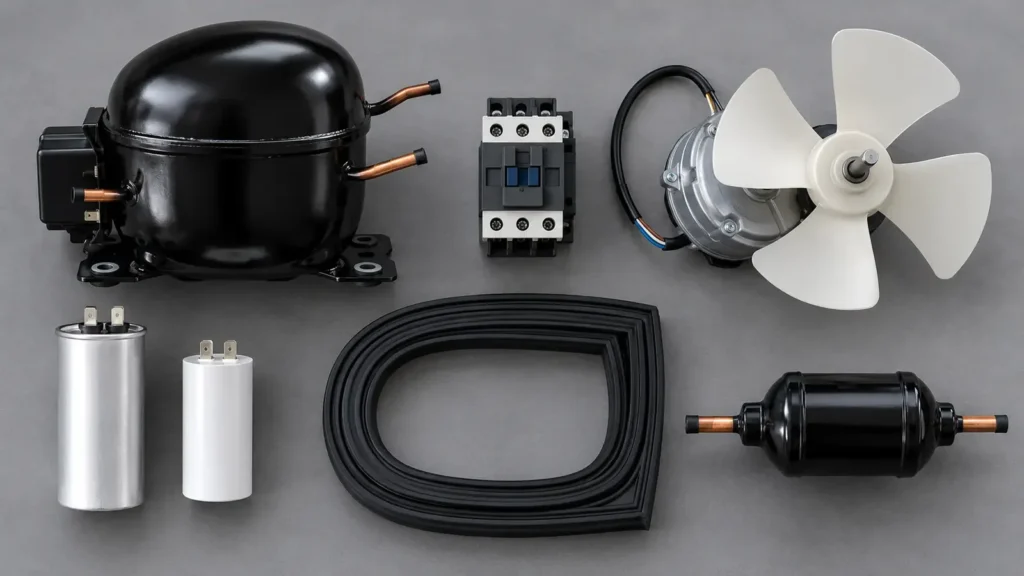
Common refrigeration parts such as fan motors, capacitors, contactors, controllers and many valves are widely available or have suitable equivalents. Brand-specific box parts, such as certain door closers, heater wires and gasket profiles, may need ordering. Giving the technician nameplate photos when you call lets them check availability before the visit, which can save a second trip.
When equipment is very old
Some walk-ins in service around Mississippi are decades old. Parts for discontinued models can be hard to find, and older refrigerants are being phased down. That does not always mean replacement, but it does mean planning. Ask the technician which parts are likely to be hard to source and whether a staged upgrade would make sense. See upgrades and retrofits and R-22 phase-out.
Keeping an equipment file
- Nameplate photos for the box, condensing unit, evaporator and compressor.
- Installation date and installer.
- Refrigerant type and charge.
- Controller settings.
- Every repair invoice, with the cause and parts used.
Brand repair pages
Walk in cooler repair Experts is an independent service and repairs walk-ins from many makers. Brand-specific notes are on these pages:
- Kolpak walk-in repair
- Master-Bilt walk-in repair
- Nor-Lake walk-in repair
- Bally walk-in repair
- Polar King walk-in repair
- Heatcraft walk-in repair
- Bohn walk-in repair
- Russell walk-in repair
Questions about walk-in cooler brands
Can you repair any brand of walk-in?
Walk-in coolers share the same refrigeration principles, so most makes can be diagnosed and repaired. Call with your nameplate details.
My walk-in has no label. Is that a problem?
No. The technician can work from the refrigeration nameplates and measurements.
Do I need original-brand parts?
For some door and box parts, matching matters. Many refrigeration parts have suitable equivalents.