
Commercial kitchens and stores use several kinds of refrigeration: walk-in coolers and freezers for bulk storage, reach-ins and undercounter units at the line, prep tables for ingredients, display cases for sale, ice machines and blast chillers. They share the same refrigeration cycle but differ in size, design and how they fail. This site focuses on walk-ins.
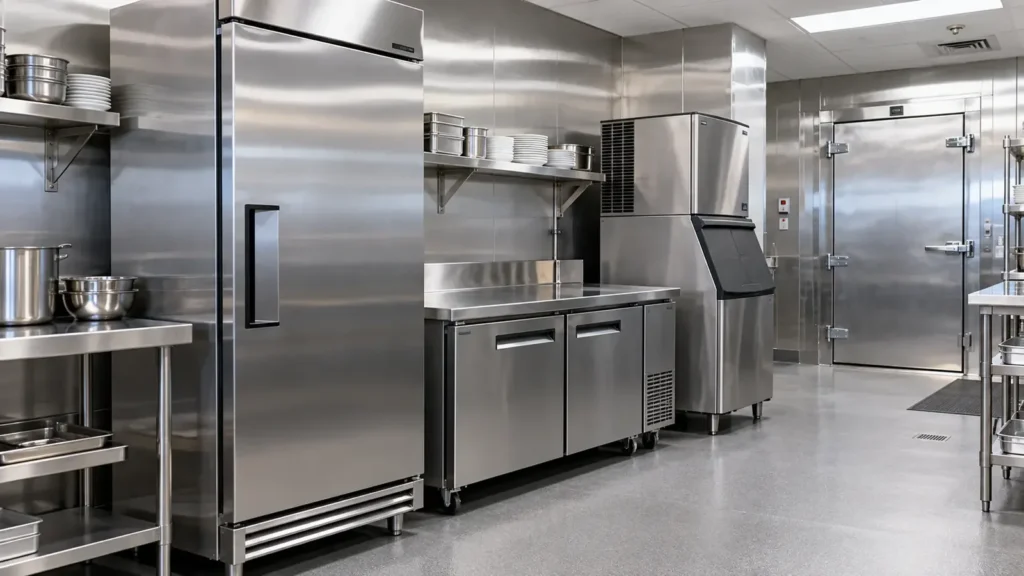
If you run a kitchen, store or venue, you probably have more than one type of refrigeration. Knowing how they differ helps you describe problems, plan maintenance and buy the right equipment.
The main types
| Equipment | Role | Typical issues |
|---|---|---|
| Walk-in cooler | Bulk cold storage you can enter | Warm box, door leaks, dirty coils, fan faults |
| Walk-in freezer | Bulk frozen storage | Defrost, ice, heaters, frozen doors |
| Reach-in refrigerator or freezer | Upright cabinet near the line | Door gaskets, condenser dust, fans |
| Undercounter unit | Compact storage under work surfaces | Heat from the line, blocked airflow |
| Prep table | Cold rail for ingredients with storage below | Warm pans, lids left open |
| Display case | Holds product for customers to see | Glass fogging, lighting heat, door traffic |
| Ice machine | Makes ice for drinks and food | Scale, filters, water supply |
| Blast chiller | Cools hot food fast | Overloading, defrost, sensor issues |
| Beverage and keg cooler | Holds drinks and kegs | Door traffic, warm lines |
What they share
All of these use the same basic cycle: a compressor, a condenser, an expansion device and an evaporator moving heat out of the cabinet. The same habits keep them healthy: clean condenser coils, good door seals, airflow around the unit and correct loading. See the refrigeration cycle.
Why walk-ins are different
- They are field-assembled from panels, so the box itself can fail.
- The refrigeration is often split between an indoor evaporator and an outdoor condensing unit.
- They hold far more product, so failures cost more.
- Doors are large and see heavy traffic.
- Freezers need defrost systems, heaters and safety releases.
See condensing unit vs unit cooler and self-contained vs remote.
Planning a kitchen's cold storage
A balanced kitchen uses a walk-in for bulk storage and smaller units at the point of use, so staff are not opening the walk-in for every item. That reduces door traffic and keeps the walk-in steady. When you design or expand a kitchen, think about where deliveries arrive, how food flows to the line and how much cold storage each station needs. See the new restaurant checklist and sizing and load calculation.
Maintenance across all equipment
- Clean condenser coils on a schedule.
- Check door gaskets monthly.
- Keep airflow clear around every unit.
- Log temperatures for each unit.
- Book a yearly service visit.
See the maintenance guide.
Food safety across equipment
Every unit holding temperature-controlled food must keep it at 41 degrees Fahrenheit or below. Check each unit with a thermometer and keep logs. See food safety in Mississippi.
Our focus
Walk in cooler repair Experts focuses on walk-in coolers and freezers and the parts that keep them running. For a walk-in problem, see the troubleshooting guide or call.
How to describe a problem with any unit
Whatever the equipment, the same details help a technician: what the unit is, what temperature it reads and what it should read, whether the compressor and fans run, whether you see ice, water or oil, and when the problem started. A photo of the nameplate saves time because it gives the model, voltage and refrigerant. For walk-ins, also note whether the door seals and whether the outdoor unit is clean.
Choosing equipment for a new or expanding kitchen
| Need | Typical choice |
|---|---|
| Bulk storage of deliveries | Walk-in cooler and freezer |
| Ingredients at the line | Reach-ins, undercounter units and prep tables |
| Cooling cooked food quickly | Blast chiller or shallow pans and ice baths |
| Drinks for customers | Display coolers or glass-door walk-ins |
| Ice for drinks and displays | Ice machine with water filtration |
Size the walk-in for your deliveries plus growth, and size the line units so staff rarely need to enter the walk-in during service.
Energy and heat in the kitchen
Every self-contained unit releases heat into the room. A kitchen packed with reach-ins and undercounter units gets hotter, which makes every unit work harder, including the walk-in. Ventilation, clear space around units and remote condensing units for larger equipment help. Efficient equipment and clean coils reduce both power bills and kitchen heat. See cost to run a walk-in.
Lifespan and replacement planning
Commercial refrigeration wears out at different rates. Small self-contained units are often replaced as a whole when the compressor fails. Walk-ins are usually repaired part by part, with the box lasting much longer than the refrigeration. Keep a list of every unit with its age and repair history, and plan replacements before failures force the decision. See how long a walk-in lasts and the repair or replace guide.
Storm and power planning
A power outage affects every unit at once. Decide in advance which units are most important, where food will go and how equipment will be restarted. Surge protection on larger units protects compressors. See storm prep.
Records for the whole kitchen
Keep one temperature log that covers every unit, with columns for each. A single sheet makes it easy for staff to check everything in one pass and for managers to spot a unit that is drifting. Keep repair invoices together by unit so you can see which equipment costs the most to keep running. See temperature logs.
Questions about commercial refrigeration equipment guide
Is a reach-in the same as a walk-in?
No. A reach-in is a self-contained cabinet. A walk-in is a room built from panels.
Do these units need the same maintenance?
The basics are the same: clean coils, good seals, clear airflow and regular checks.
Do you repair walk-in coolers and freezers?
Yes. Walk-in coolers and freezers are the focus of this business.